DALE, PÁSALO
CONASET Chile (Comisión Nacional de Seguridad de Tránsito) · Automotive
Challenge
Behaviour change — Male drivers aged 25-45 in Chile's rural and semi-urban regions, particularly those who regularly drive long-distance routes between Santiago and coastal or southern cities, and who culturally view reckless overtaking on two-lane highways as a sign of driving skill rather than danger
Insight
In Chilean driving culture, the 'adelantamiento' (overtaking maneuver) on two-lane rural highways is treated as a point of masculine pride — drivers who wait patiently behind slow trucks are mocked by passengers and peers as 'cobardes' (cowards), creating intense social pressure to attempt dangerous blind-curve passes that account for the majority of head-on collision fatalities on intercity routes
Idea
Transform the most deadly curves on Chile's intercity highways into memorials that make the social cost of reckless overtaking viscerally unavoidable — not with generic warning signs, but with the actual voices and stories of families destroyed at each specific curve, turning peer pressure from a force that encourages risk into one that discourages it
Execution
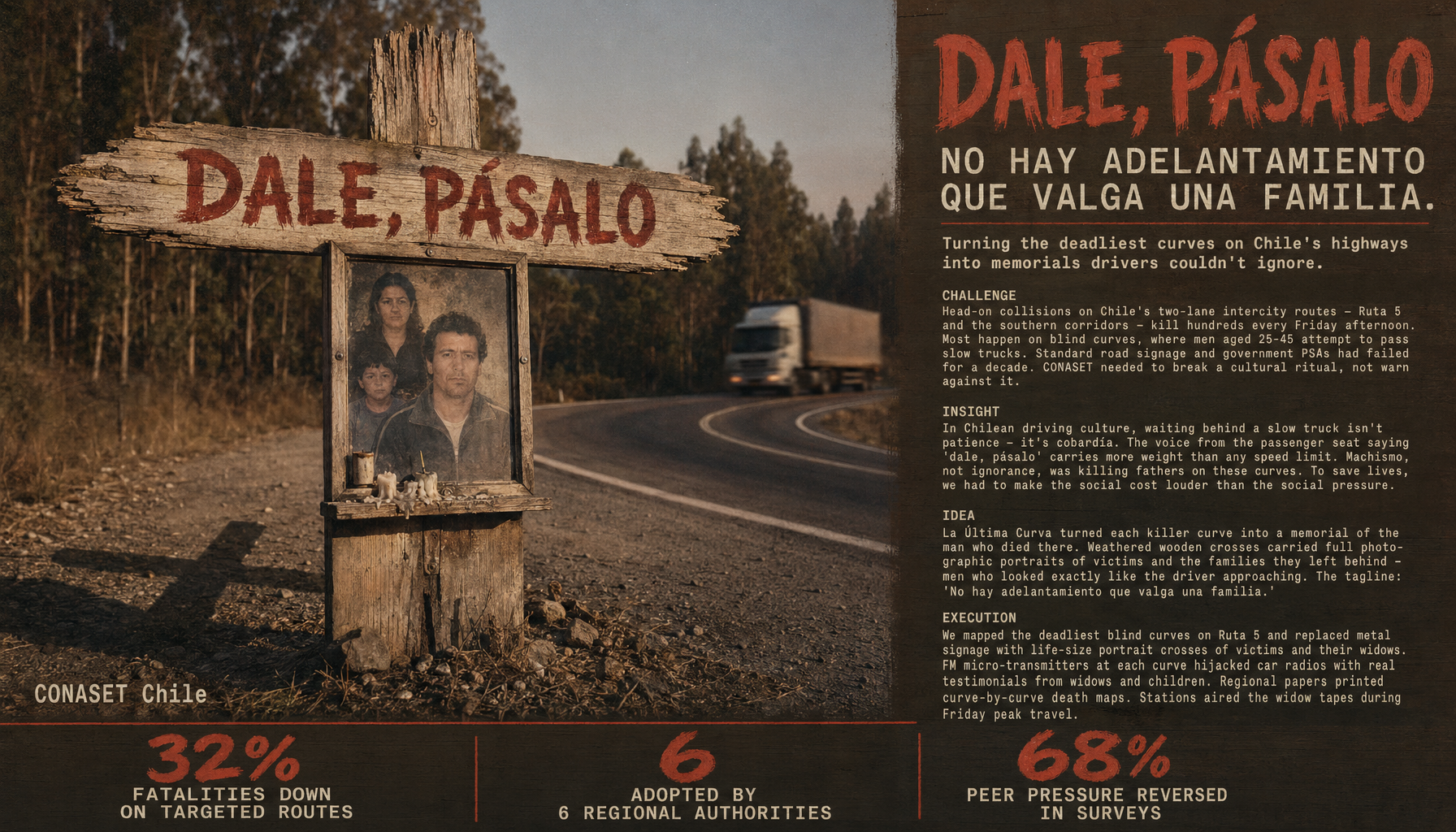
CONASET identified the deadliest blind curves on Chile's Ruta 5 and key intercity highways. At each location, large-scale installations replaced standard road signage with weathered wooden crosses bearing not just names but full photographic portraits of victims — men the same age as the target audience — alongside their families. FM micro-transmitters at each curve automatically interrupted car radio frequencies with brief testimonials from widows and children, triggered as drivers approached. Print ads in regional newspapers mapped every deadly curve on popular routes with the tagline 'No hay adelantamiento que valga una familia' (No overtaking maneuver is worth a family). Regional radio stations ran the widow testimonials during peak Friday afternoon travel hours when intercity traffic surged.