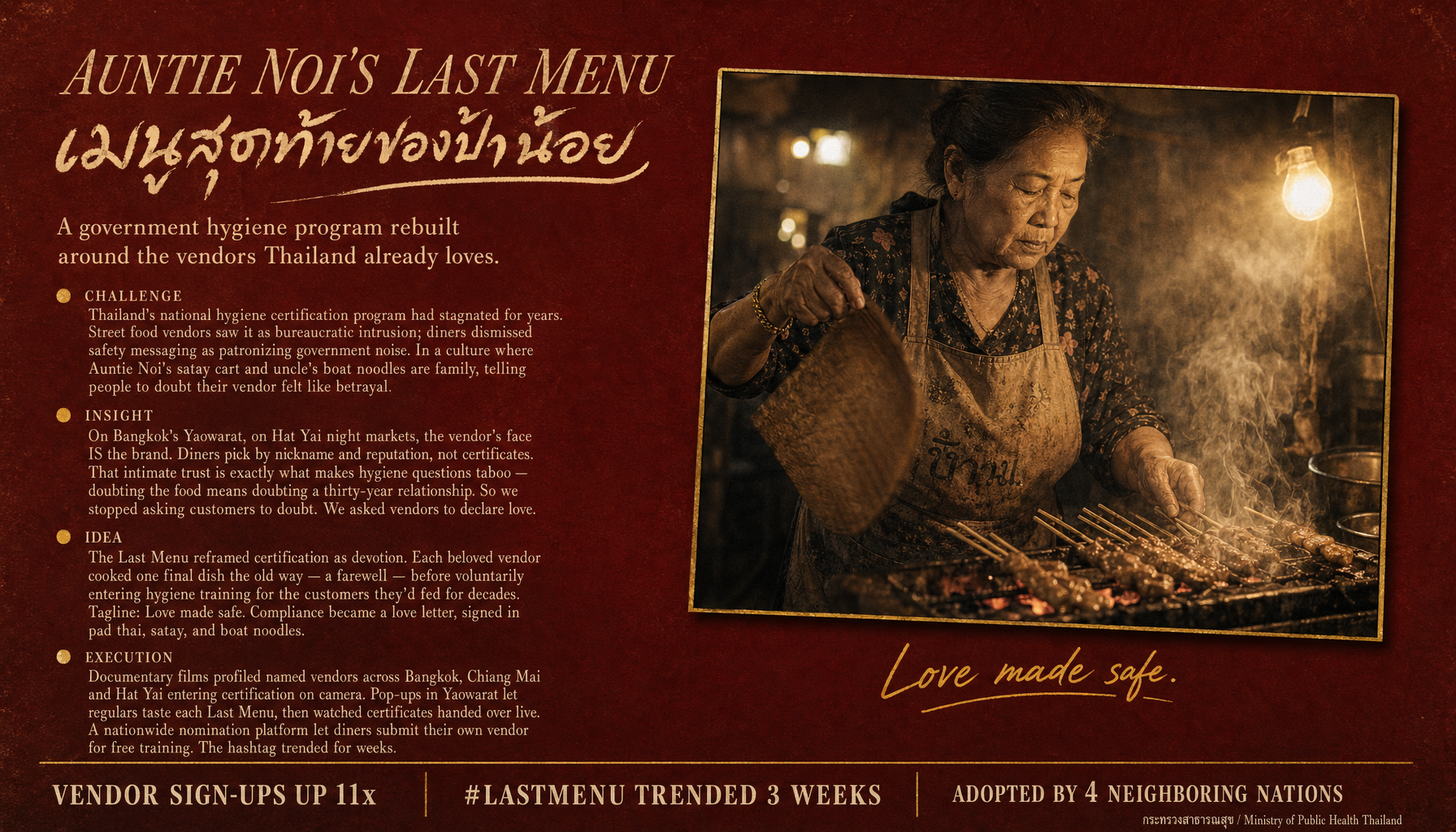
AUNTIE NOI'S LAST MENU
Ministry of Public Health Thailand · QSR
Challenge
Awareness — Urban millennials and Gen-Z consumers across Southeast Asia who eat from street food vendors daily, consider street food central to their cultural identity, but rarely question hygiene practices — viewing food safety messaging as patronizing government propaganda they instinctively tune out.
Insight
In street food cultures, the vendor's face is the brand. Diners choose stalls based on the personality and reputation of the cook, not hygiene certificates. This deep personal trust actually makes people less likely to question food safety — because doubting the food feels like doubting a relationship.
Idea
Instead of telling people to distrust their favorite vendors, the campaign celebrated those vendors by name — then revealed that even the most beloved cooks wanted official hygiene training to protect the customers they cared about. 'The Last Menu' positioned food safety certification not as government oversight, but as a love letter from vendor to customer.
Execution
The campaign profiled real, iconic street food vendors in Bangkok, Chiang Mai, and Hat Yai — each known by nickname and loyal following. Short documentary films showed them voluntarily entering government hygiene certification, framed not as compliance but as devotion to their regulars. Each vendor created a 'Last Menu' — one final dish cooked the old way before upgrading their kitchen practices. These farewell dishes were served at pop-up events where customers could taste them, then watch the vendor receive their hygiene certificate live. Social content invited diners to nominate their own beloved vendors for free certification, turning a public health initiative into a grassroots movement powered by food nostalgia and personal loyalty.