READ THE WHOLE LABEL
FairBasket · FMCG
Challenge
Cultural relevance — Urban, college-educated grocery shoppers aged 28-45 who identify as ethically minded consumers, actively read ingredient labels, and follow food culture through media like Bon Appétit, food TikTok, and farmers' market culture — but whose ethical attention stops at what's inside the package, not who picked it
Insight
The clean-label movement taught a generation of shoppers to scrutinize every ingredient on the back of a package, yet the one input they never see listed is the human labor that harvested it. Americans had learned to care deeply about what goes into their food but had been given no visual or informational framework to care about who touches it before it reaches the shelf — making farmworker exploitation not a secret, but an unlabeled ingredient.
Idea
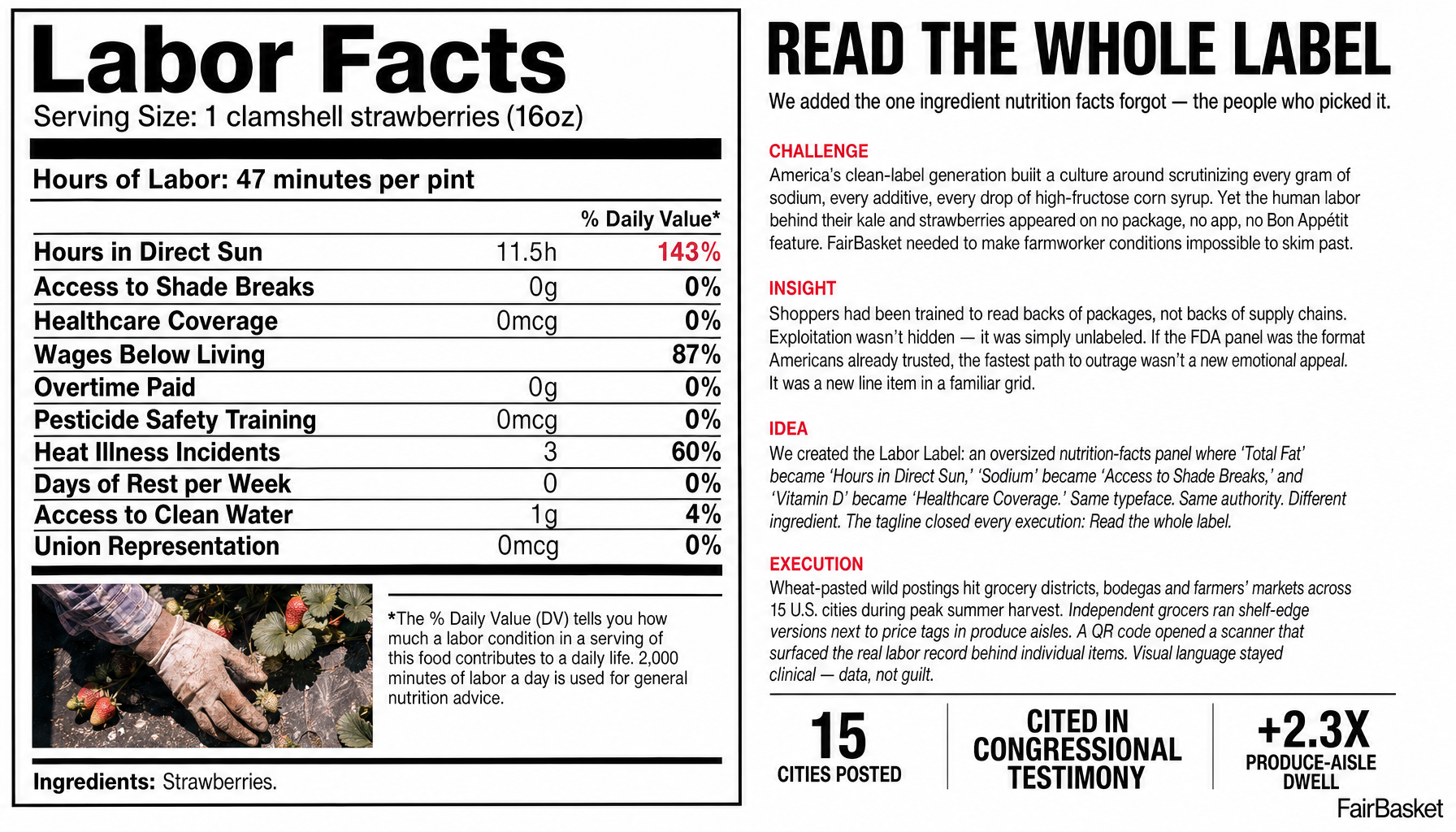
Add the missing ingredient. FairBasket created 'Labor Labels' — OOH installations in grocery districts that reimagined familiar nutrition-facts panels with a new line item: the human cost, listing the working conditions, average pay gap, and heat exposure behind everyday produce, forcing the clean-label generation to apply the same scrutiny they give to additives to the people behind their food.
Execution
Oversized nutrition-facts panels were wheat-pasted and installed as wild postings outside grocery stores, bodegas, and farmers' markets in fifteen major U.S. cities during peak summer harvest season. Each poster mimicked the exact FDA label format consumers already knew how to read, but replaced familiar rows like 'Total Fat' and 'Sodium' with lines such as 'Hours in Direct Sun,' 'Access to Shade Breaks,' and 'Healthcare Coverage.' A QR code linked to a mobile experience where users could scan actual produce in-store and see a real-time 'labor label' for that item's supply chain. Participating independent grocers placed shelf-edge versions of the labels in produce aisles, turning the entire shopping trip into an act of confrontation with the information gap. The visual language was deliberately clinical, not emotional — it trusted consumers to feel outrage through data presentation they already respected, rather than through guilt-driven imagery.