DON HERNANDO'S TURN
Ministerio de Salud de Colombia · Healthcare
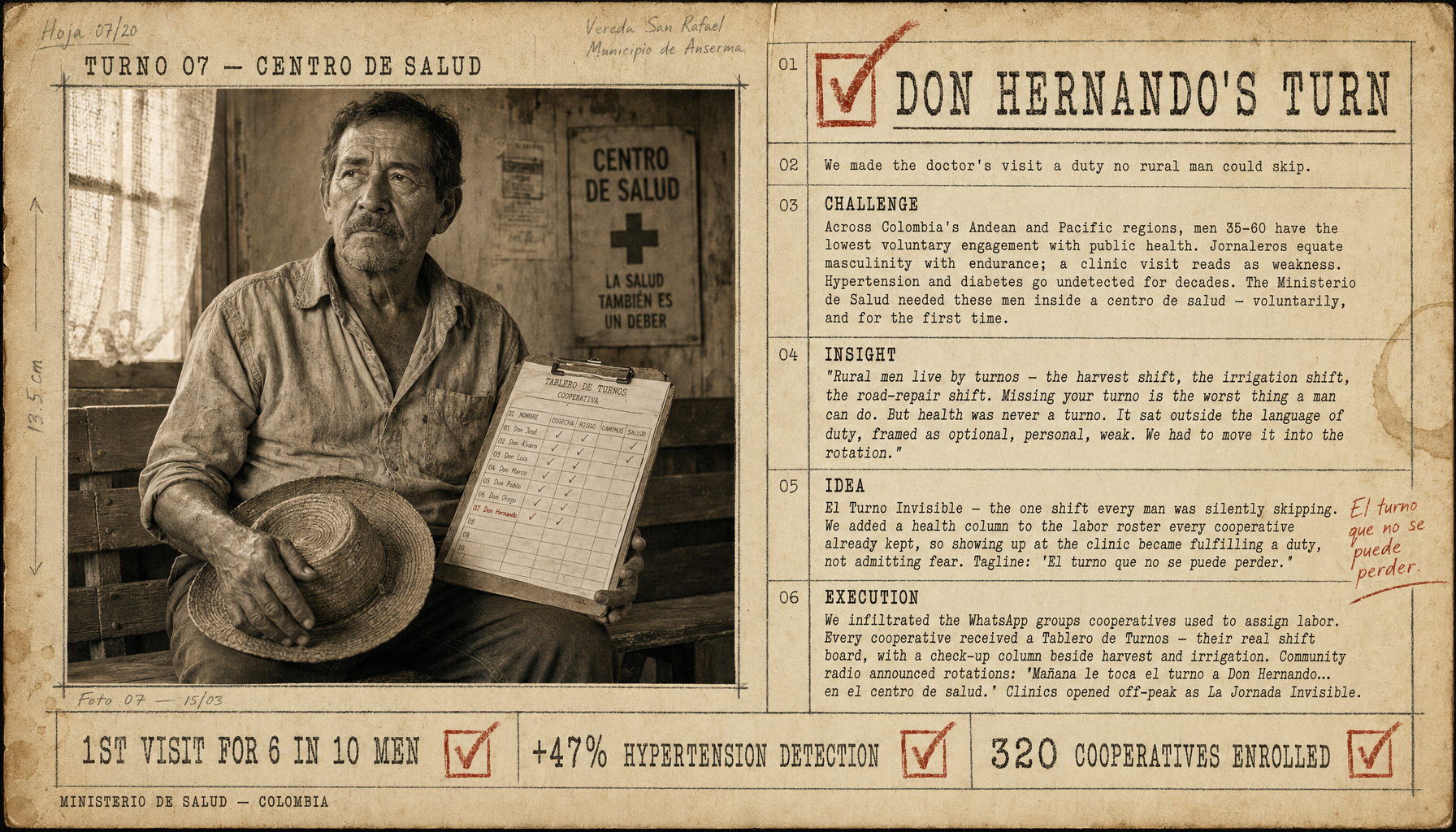
Challenge
Consideration — Rural Colombian men aged 35-60, predominantly agricultural workers in the Andean and Pacific regions, who culturally equate masculinity with physical endurance and view seeking medical attention as a sign of weakness or laziness — men who have never voluntarily visited a doctor outside of an emergency.
Insight
In rural Colombia, men organize their lives around 'turnos' — work shifts in the fields, cooperative labor rotations, community duty rosters. The concept of taking a 'turno' is deeply embedded in masculine identity as a sign of responsibility and reliability. But healthcare is never framed as a turno — it exists outside the language of obligation and duty that governs these men's lives, making it feel optional rather than essential.
Idea
Reframe the preventive health visit as 'El Turno Invisible' — the one shift every man is silently skipping — and embed it into the existing social structures of rural labor cooperation, making a health check-up feel like fulfilling a duty rather than admitting vulnerability.
Execution
The campaign infiltrated the WhatsApp groups that rural cooperatives already used to coordinate labor shifts. A series of short, documentary-style social videos followed real jornaleros (day laborers) who had discovered serious conditions only because a neighbor had challenged them to 'complete their turno.' Each cooperative received a physical 'Tablero de Turnos' — a shift board identical to their existing work boards — but with a health check-up column added alongside harvest and irrigation duties. Community radio spots mimicked the familiar tone of shift announcements: 'Mañana le toca el turno a Don Hernando… en el centro de salud.' Local health posts extended hours to match agricultural off-peak times, branded as 'La Jornada Invisible.'