A BETTER WAY TO WAIT
MediAsia · Healthcare
Challenge
Behaviour change — Working adults aged 35-55 across Southeast Asia, particularly in Singapore, Thailand, and the Philippines — a demographic that culturally equates visiting a doctor with admitting weakness, and who routinely delay or skip preventive health screenings despite having employer-provided insurance coverage.
Insight
In many Southeast Asian cultures, the act of sitting in a clinic waiting room carries a deep social stigma — it signals to yourself and others that something is wrong with you. People will endure symptoms for months rather than be seen entering a medical facility, because the waiting room is psychologically coded as a space of illness, not prevention. The barrier to screening isn't cost or access — it's the shame of the threshold itself.
Idea
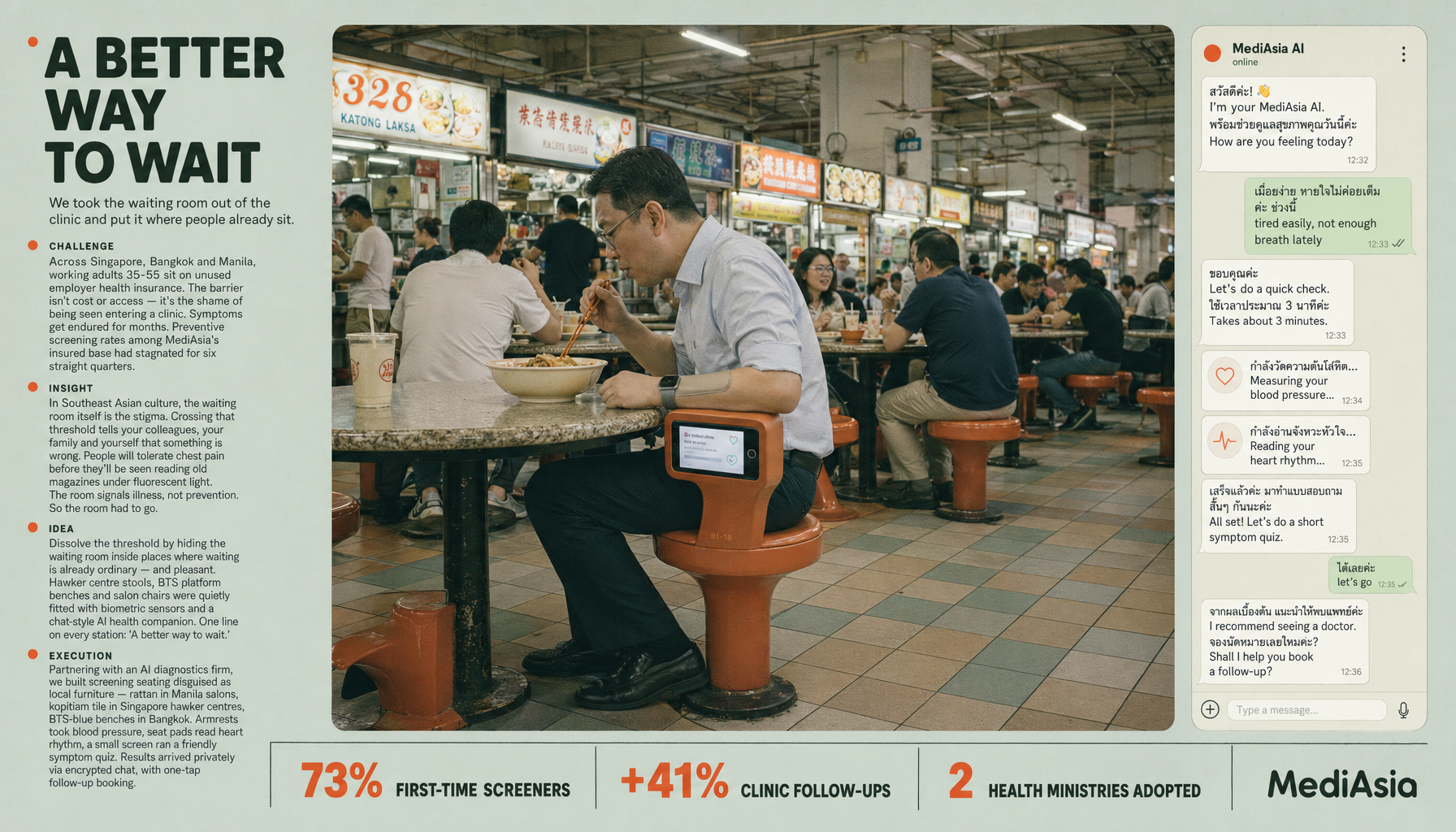
Dissolve the stigma of the waiting room by taking it out of the clinic entirely and embedding it — along with real-time AI-powered health screening tools — inside spaces where sitting and waiting already feels normal: hawker centres, MRT stations, barbershops, and nail salons across three countries.
Execution
MediAsia partnered with an AI diagnostics company to build portable screening stations disguised as ordinary seating in everyday waiting environments. Chairs at popular hawker centres in Singapore, BTS platform benches in Bangkok, and salon waiting areas in Manila were fitted with subtle biometric sensors and paired with a conversational AI health assistant on a discreet screen. While people waited for their food, train, or appointment, they could opt into a casual, chat-style health check — blood pressure via armrest sensors, heart rhythm via seat pad, and an AI-guided symptom questionnaire presented as a light interactive quiz. Results were delivered privately via encrypted messaging app. The entire experience was branded not as a medical intervention but as 'a better way to wait' — reframing idle time as self-care time. Each installation was designed by local artists to blend seamlessly into the cultural fabric of each location, avoiding any clinical aesthetic.