LA VECINA SOY YO
Sanari · Healthcare
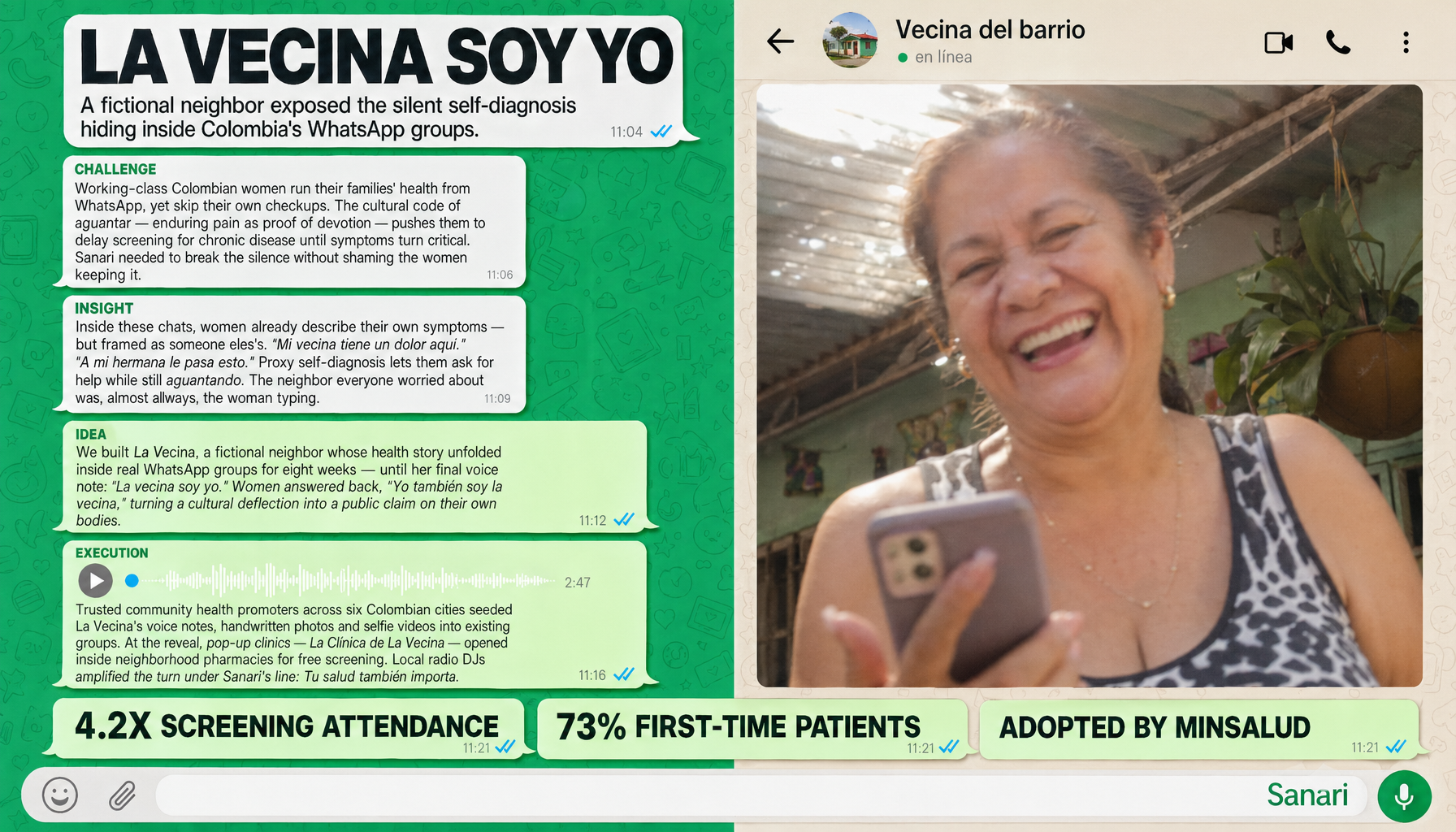
Challenge
Awareness — Working-class women aged 30-55 in Colombia's mid-sized cities — domestic workers, informal vendors, and caregivers who prioritize family health over their own and habitually self-diagnose using WhatsApp group chats rather than consulting doctors
Insight
In Colombian working-class WhatsApp groups, women routinely share health advice with each other, but a deeply embedded cultural norm of 'aguantar' — enduring pain silently as proof of strength and devotion to family — means they describe their own symptoms to the group only when framing them as someone else's problem. A woman will type 'my neighbor has this pain' or 'my sister feels this' when she is actually describing herself, creating a widespread pattern of proxy self-diagnosis that delays critical early detection of chronic diseases.
Idea
Intercept the culture of proxy self-diagnosis by creating 'La Vecina' (The Neighbor) — a fictional character whose escalating health story was seeded into real WhatsApp community dynamics, eventually revealing that 'la vecina' was every woman in the group, prompting them to claim their own symptoms and seek screening.
Execution
Sanari partnered with community health promoters — trusted women already embedded in local WhatsApp networks across six Colombian cities — to introduce 'La Vecina,' a serialized character whose symptoms were shared as voice notes, photos of handwritten notes, and short selfie-style videos, all mimicking the organic aesthetic of real group chat content. Over eight weeks, La Vecina's story progressed from vague discomfort to a pivotal moment where she revealed she had been describing herself all along and finally visited a clinic. At that turning point, Sanari deployed pop-up screening stations at neighborhood pharmacies branded as 'La Clínica de La Vecina,' offering free basic health checks. Local radio DJs — voices already trusted in these communities — echoed the story and encouraged women to stop 'aguantando' and start claiming their own health narratives.