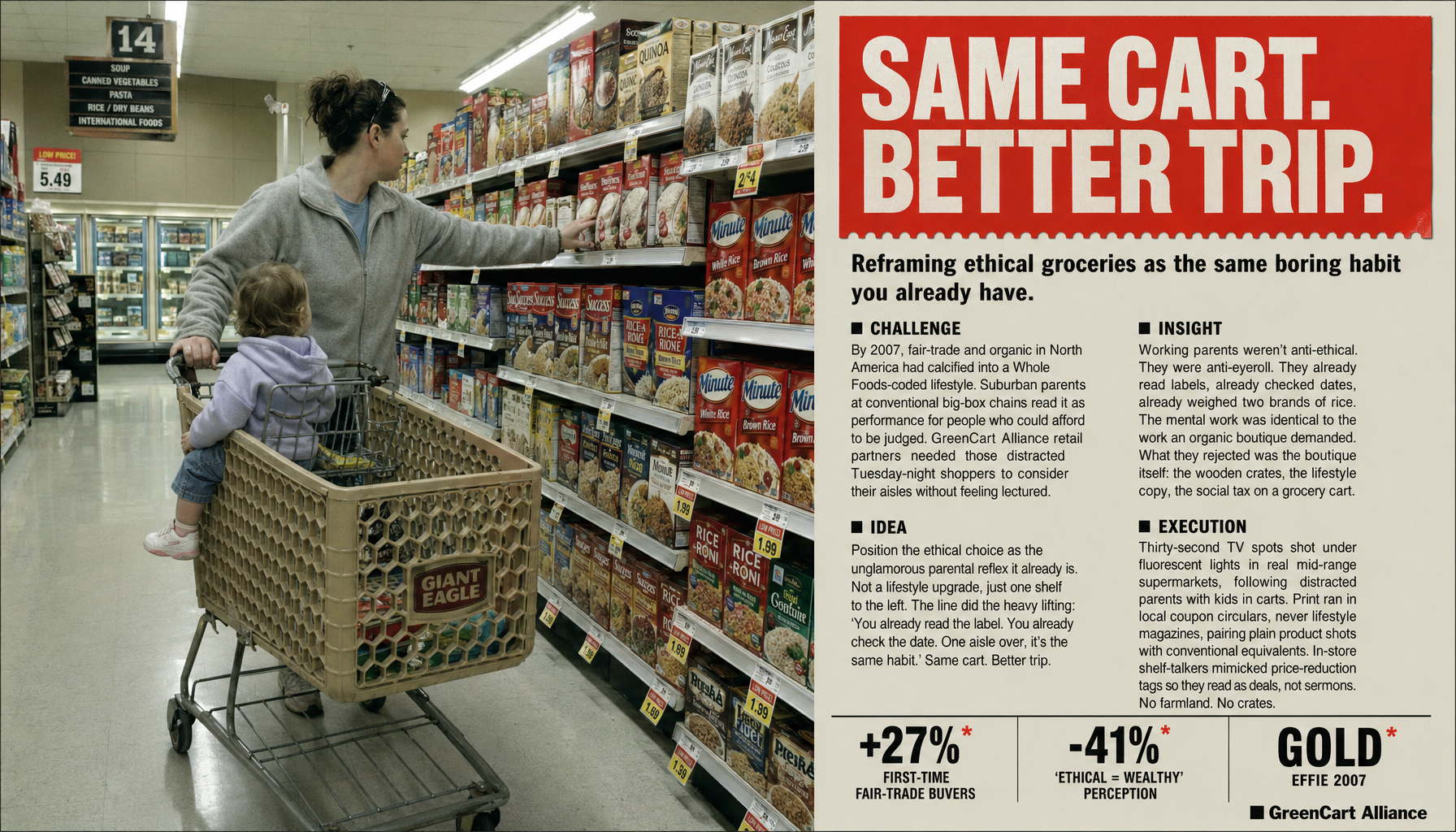
SAME CART. BETTER TRIP.
GreenCart Alliance · Retail
Challenge
Consideration — Suburban parents aged 30-50 who shop at conventional big-box grocery chains, consider themselves pragmatic household providers rather than 'activists,' and feel alienated by the perceived elitism and higher cost of organic and fair-trade retail
Insight
In the mid-2000s, ethical shopping in North America had become coded as an upper-middle-class lifestyle choice — organic stores felt like boutiques for the already-privileged. Working parents didn't reject ethical consumption on principle; they rejected the social performance that surrounded it, feeling that 'shopping with a conscience' was something done by people who could afford to be judged for their grocery cart.
Idea
Reframe ethical retail not as a lifestyle upgrade but as a quiet, unglamorous parental instinct — something you do in the same unremarkable way you check the expiration date on milk — by showing that the 'other aisle' already exists in the stores you already trust.
Execution
A series of thirty-second TV spots shot in the fluorescent, unglamorous reality of actual mid-range grocery stores — no lush farmland, no artful wooden crates. Each spot followed a real-looking parent doing their usual distracted, kid-in-the-cart shopping run, and pausing at one mundane decision point: a bag of rice, a carton of eggs, a jar of coffee. A simple voiceover said, 'You already read the label. You already check the date. One aisle over, it's the same habit.' Print ads ran in local coupon circulars — deliberately not in lifestyle magazines — featuring plain product shots beside their conventional equivalents with the tagline 'Same cart. Better trip.' In-store shelf-talkers used the same visual language as price-reduction tags so they'd feel familiar rather than preachy.