SEE WHAT'S ON THE SHELF
FairShare Foundation · FMCG
Challenge
Cultural relevance — Urban European grocery shoppers aged 25-45, socially conscious but fatigued by generic ethical messaging, who default to price and convenience over supply chain ethics despite stated values
Insight
In the AI era, consumers have become skilled at ignoring ethical claims on packaging because every brand now uses the same fair-trade visual language — green leaves, smiling farmers, certification stamps. The sheer uniformity of 'ethical aesthetics' has made genuine exploitation invisible by making everything look equally virtuous.
Idea
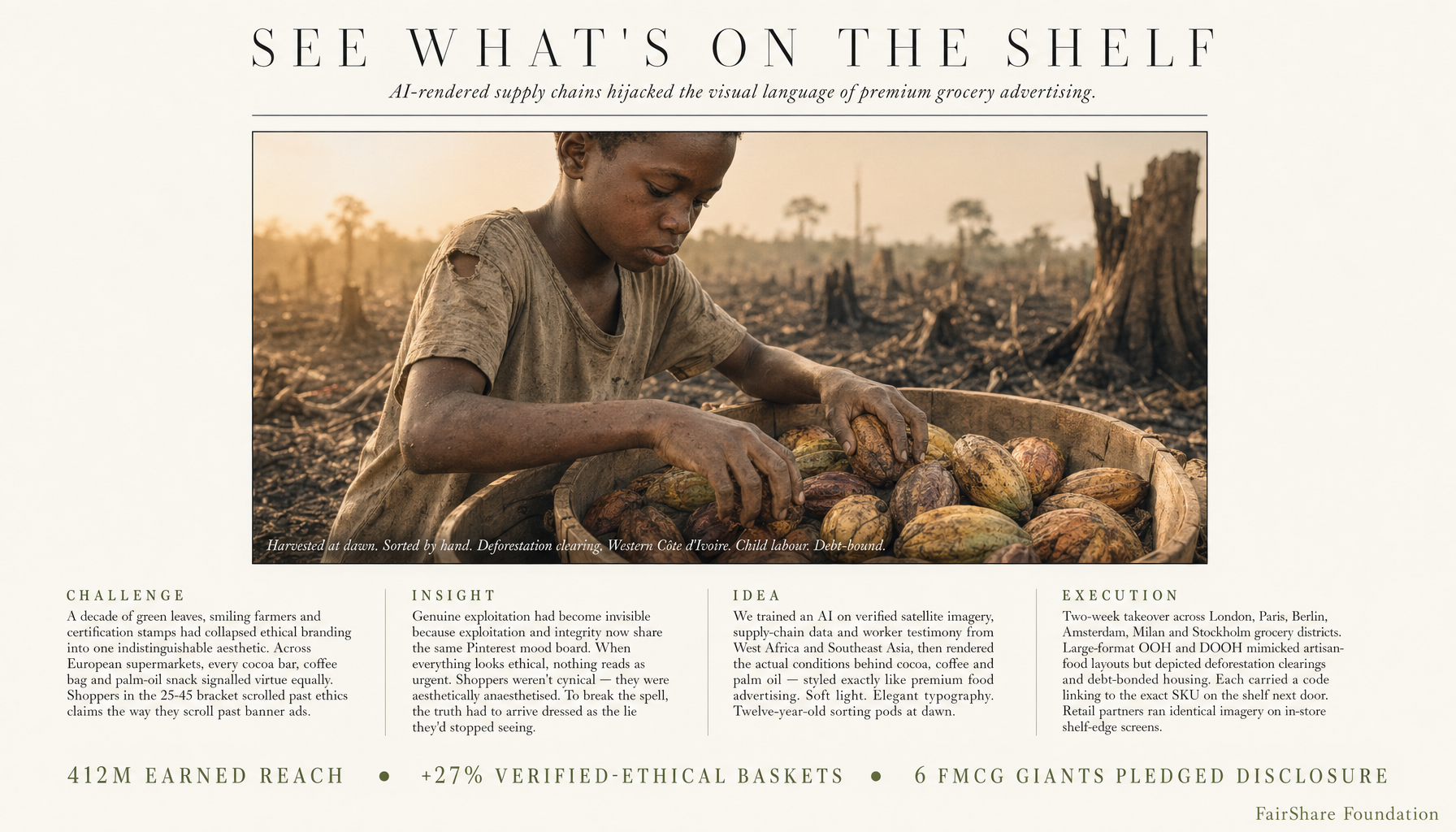
Strip supermarket shelves bare of every ethical signifier — the green imagery, the smiling faces, the certification logos — and replace them with AI-generated reconstructions of the actual labour conditions behind each product, turning out-of-home spaces into confrontational mirrors of supply chain reality that shoppers could no longer aesthetically tune out.
Execution
FairShare partnered with an investigative data collective to train an AI model on verified supply chain photography, satellite imagery, and worker testimony from cocoa, coffee, and palm oil production. The model generated hyper-specific, location-accurate visual reconstructions of harvesting conditions — not stock imagery, but composite portraits of real places rendered in an unsettling photorealistic style. These images were displayed on large-format OOH and digital screens in major European grocery districts, formatted to mimic the familiar aesthetic of premium food advertising — soft lighting, elegant typography — but depicting child labour stations, deforestation clearings, and debt-bonded worker housing. Each execution carried a single scannable code linking to the specific product on the shelf inside the adjacent supermarket. Retail partners allowed in-store shelf-edge screens to carry the same imagery during a two-week activation period across six European cities.