YOUR BODY ALREADY KNOWS
Ministry of Public Health Finland · Healthcare
Challenge
Behaviour change — Adults aged 25-45 living in Nordic and Northern European urban centres who are professionally connected but socially isolated, high digital literacy, aware of wellness culture yet resistant to messaging that frames loneliness as personal failure.
Insight
In Finland and across Northern Europe, loneliness has been medicalised in public health campaigns for years, yet isolation rates keep climbing — because people don't identify as 'lonely.' They identify as 'busy,' 'independent,' or 'introverted.' The word 'loneliness' itself has become a psychological shield: as long as you don't name it, you don't have to confront its physical toll on your body.
Idea
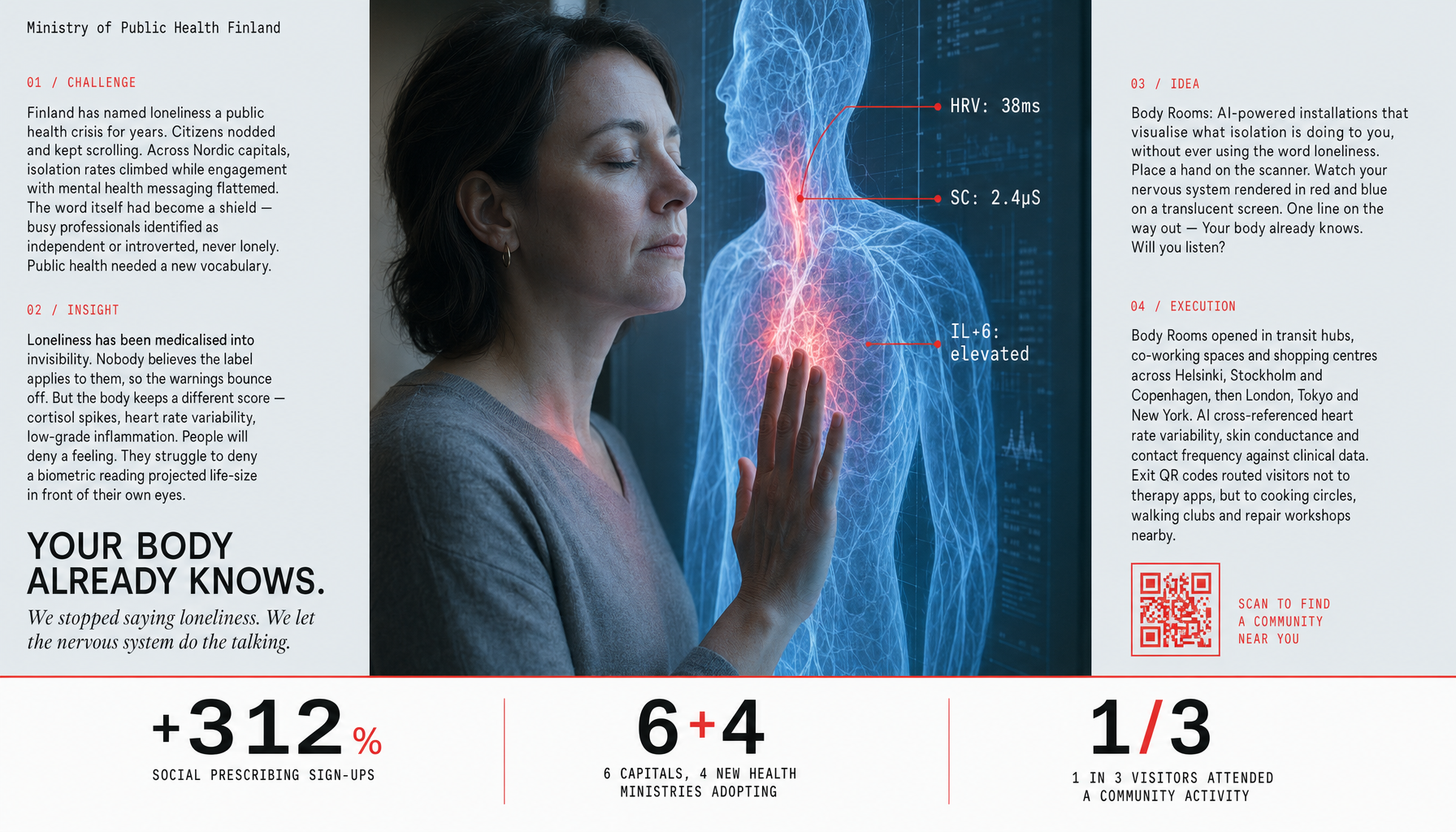
Instead of telling people they're lonely, show them what loneliness is already doing to their bodies — using AI-powered biometric installations that visualise the real-time physiological markers of social isolation (elevated cortisol patterns, heart rate variability, inflammation indicators) without ever using the word 'lonely.'
Execution
Pop-up installations called 'Body Rooms' were placed in high-traffic urban locations — transit hubs, co-working spaces, and shopping centres — across Helsinki, Stockholm, Copenhagen, and later London, Tokyo, and New York. Participants entered alone, placed their hand on a biometric scanner, and an AI model cross-referenced their real-time heart rate variability, skin conductance, and self-reported social contact frequency against clinical loneliness research. A personalised, abstract visualisation of their body's stress state was then projected life-size onto a translucent screen in front of them — inflamed areas glowing red, calm areas rendered in cool blue. No diagnosis was given. No label. Just a mirror of what their body was carrying. At the exit, a simple prompt read: 'Your body already knows. Will you listen?' alongside a QR code linking to a government-backed social prescribing platform connecting users to local community activities — not therapy, not apps, but real-world group experiences like cooking circles, walking clubs, and repair workshops.